
Western Australia’s mining and resources industry operates in conditions where distance, downtime, and durability define success. Equipment works harder, logistics stretch longer, and replacement timelines often determine operational efficiency. Industrial 3D printing has moved from experimental technology to a practical manufacturing companion, helping resource companies rethink how parts are designed, produced, and maintained.
At Telespace, we work with advanced 3D printing processes that allow engineers, businesses, and innovators to transform digital designs into precise physical components using tailored materials and reliable production workflows. The same flexibility that benefits product developers is increasingly valuable across mining environments where adaptability matters as much as strength.
When Distance Becomes the Real Engineering Challenge
Mining operations across Western Australia rarely sit near traditional manufacturing hubs. Replacement components can take days or weeks to arrive, especially when specialised parts must be sourced internationally.
Additive manufacturing changes this equation.
Instead of waiting for supply chains, teams can manufacture parts closer to where they are needed. Digital files replace warehouses filled with rarely used spares, allowing components to be produced on demand.
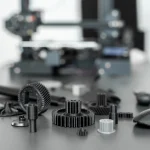
Consider situations where machinery stops because of a small plastic housing, bracket, or protective enclosure. These are not complex assemblies, yet they halt multimillion-dollar operations. Industrial 3D printing enables rapid reproduction of such components with accurate dimensions and repeatability.
[LINK-NEXT:Reducing production delays often has less to do with machinery speed and more to do with how quickly physical parts can be created when needed.]
This shift quietly alters how maintenance planning works across remote sites.
Rapid Prototyping for Harsh Operating Conditions
Mining environments are unforgiving. Dust, vibration, heat, and mechanical stress expose design weaknesses quickly. Traditional manufacturing forces teams to commit to tooling before validating whether a design truly performs under real conditions.
3D printing allows iterative development.
Engineers can test multiple design variations without committing to expensive moulds or machining runs. Protective casings, airflow guides, mounting systems, sensor brackets, and ergonomic tools can all be refined through rapid prototyping cycles.
A typical workflow looks less like a single production decision and more like continuous improvement:
- Design adjustment based on field feedback
- Fast prototype production
- On-site testing
- Immediate redesign if required
Because parts can be printed directly from uploaded design files, projects move from concept to testing with minimal friction. Request a quote for custom 3D printing processes demonstrate how streamlined modern additive manufacturing has become, reducing administrative barriers between design and production.
Custom Tooling and Operational Efficiency
Mining companies rely heavily on specialised tools that rarely exist as off-the-shelf products. Custom jigs, alignment tools, cable organisers, and inspection aids often need to be fabricated manually.
3D printing introduces a faster route.
Instead of machining metal prototypes or outsourcing small fabrication jobs, teams can develop lightweight, purpose-built tools tailored to specific equipment. These tools often improve worker safety and efficiency because they are designed around real operational workflows rather than generic specifications.
Examples include:
- Cable routing guides designed for confined equipment spaces
- Protective covers preventing debris intrusion
- Measurement fixtures ensuring consistent alignment
- Ergonomic handling aids reducing strain during maintenance
[LINK-NEXT:When production adapts to exact operational needs rather than forcing operations to adapt to available parts, efficiency gains appear naturally.]
Such improvements rarely attract attention individually, yet collectively they influence productivity across entire sites.
Extending Equipment Life Through Replacement Parts
One of the most practical applications of industrial 3D printing in mining is legacy equipment support.
Many operations rely on machinery that remains mechanically reliable but suffers from discontinued components. Manufacturers may no longer produce certain housings, knobs, mounts, or protective elements. Traditionally, this leads to costly redesigns or premature equipment replacement.
Additive manufacturing offers another path.
Using existing components as references, replacement parts can be recreated digitally and reproduced with modern materials. This approach helps extend operational lifespan while avoiding unnecessary capital expenditure.
The ability to produce small batches economically is especially valuable. Traditional manufacturing methods often require minimum order quantities that exceed actual demand, whereas 3D printing supports single-part production without excessive setup costs.
[LINK-NEXT:In many cases, savings emerge not from cheaper materials but from avoiding overproduction, storage, and transport altogether.]
Lightweight Design and Material Efficiency
Industrial design has historically been constrained by subtractive manufacturing processes. Parts were shaped by removing material, which limited internal geometries and often resulted in heavier components.
3D printing removes many of these constraints.
Complex internal structures such as lattice patterns or hollow reinforcement channels can be produced without additional manufacturing steps. For mining operations, lighter components can mean:
- Easier manual handling
- Reduced energy consumption in moving systems
- Lower wear on supporting assemblies
Material efficiency also improves sustainability outcomes, since additive manufacturing builds objects layer by layer using only the required material.
While metal additive manufacturing dominates heavy industrial headlines, polymer-based industrial printing remains highly relevant for non-load-bearing components, protective parts, and operational accessories that benefit from flexibility and corrosion resistance.
Digital Manufacturing and the Future Mine Site
The mining sector increasingly integrates automation, sensors, and digital monitoring systems. 3D printing fits naturally into this evolution because it transforms manufacturing into a digital workflow.
Instead of shipping physical inventory, companies maintain digital libraries of parts ready for production when required. Engineers collaborate remotely, update designs instantly, and manufacture revised components without restarting procurement cycles.
This digital-first approach aligns with broader industry shifts toward predictive maintenance and decentralised production.
Even smaller operational improvements accumulate over time. Faster prototyping leads to better equipment interfaces. Custom tooling improves worker interaction with machinery. On-demand manufacturing reduces idle inventory.
[LINK-NEXT:Time savings in industrial environments often compound quietly, appearing first as smoother workflows before becoming measurable financial advantages.]
Building Practical Innovation into Resource Operations
Industrial 3D printing is not replacing traditional manufacturing in mining. Instead, it complements existing processes by solving problems that conventional methods handle inefficiently. Its value lies in flexibility, responsiveness, and accessibility rather than scale alone.
We see additive manufacturing supporting engineers, maintenance teams, and innovators who need precise parts produced quickly and reliably. From prototyping to end-use components, modern 3D printing services provide a pathway between digital design and real-world application with minimal delay.
As Perth’s mining and resources sector continues evolving, technologies that shorten development cycles and simplify logistics will play an increasingly important role. Industrial 3D printing represents one of those practical advancements, enabling smarter production decisions without disrupting established operations.
At Telespace, our focus remains on delivering accurate, high-quality prints with flexible material options and efficient turnaround, helping businesses transform ideas into functional components when timing and precision matter most.