
Learning Beyond the Textbook
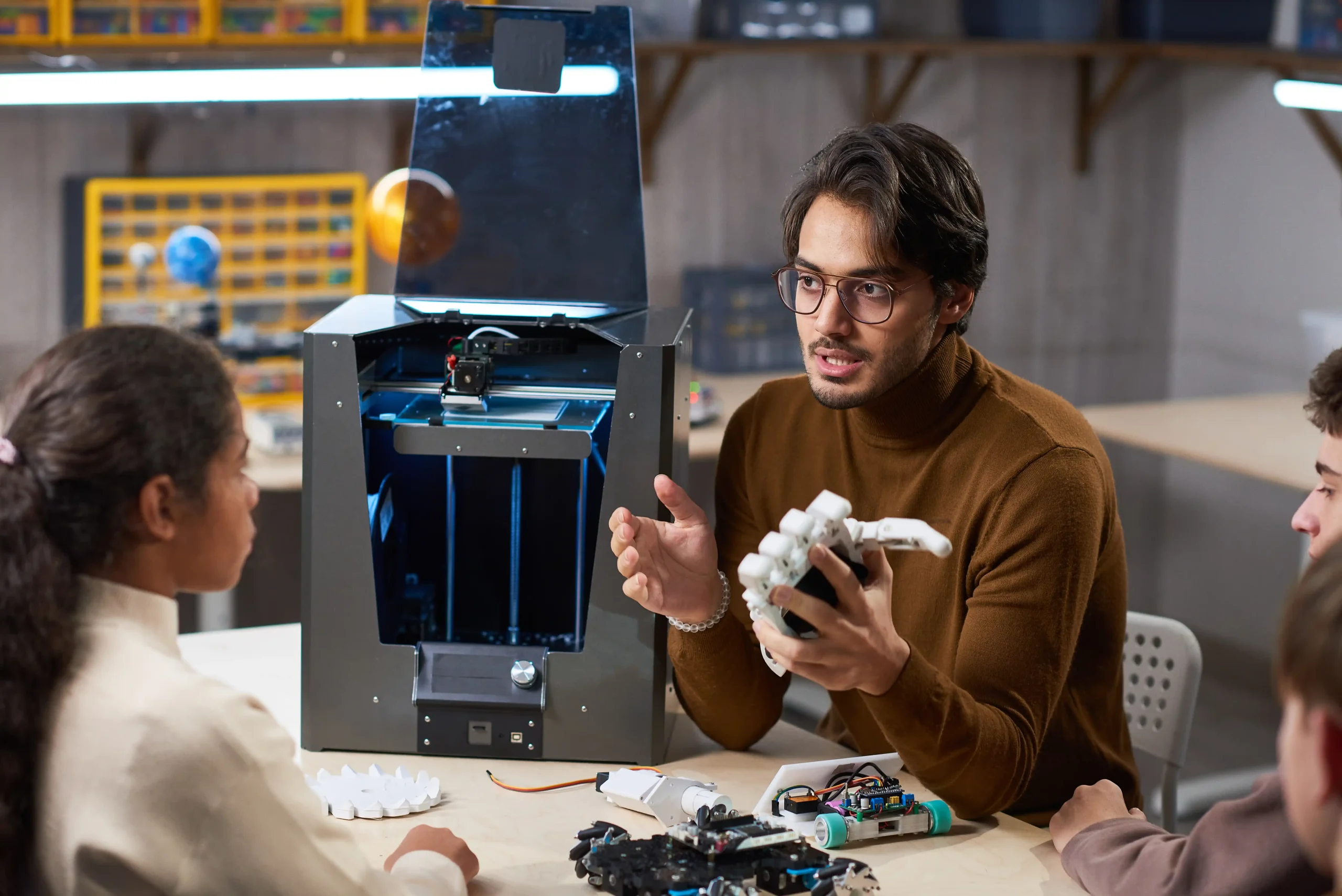
At Telespace, we’ve seen firsthand how 3D printing can transcend traditional learning methods and unlock new ways of thinking, exploring, and problem-solving. What began as a tool for prototyping and manufacturing has now entered classrooms, workshops, and homes as an interactive and highly adaptable educational asset. From sparking curiosity in young minds to providing hands-on training for adults in technical fields, 3D printing is reshaping how people of all ages learn—and we’re excited to be part of that shift.
Conventional learning methods often limit students to abstract concepts, especially in STEM fields. 3D printing changes that by turning those concepts into real-world models that students can hold, explore, and manipulate. Whether it’s building a scale replica of a historical landmark, printing molecules to understand chemical bonds, or recreating mechanical gears to understand physics principles, tactile engagement significantly improves retention and comprehension.
Studies show that physical interaction with learning materials boosts memory and problem-solving skills. With 3D printing, educators can produce classroom tools that fit specific curriculum needs—something static diagrams or videos can’t replicate. This is especially beneficial in under-resourced schools, where printable models offer affordable alternatives to expensive lab kits or commercial teaching aids.
Early Exposure, Lasting Impact
Children are natural innovators, and giving them access to 3D printing from a young age fosters creativity, critical thinking, and spatial awareness. As students design, prototype, and print their own creations, they not only learn how things are made but also understand how to think like engineers and designers.
Coding, CAD software, and digital design are no longer reserved for tertiary education. Today, primary and secondary schools increasingly include these skills in their curriculums through platforms that integrate with 3D printing. This hands-on exposure not only demystifies technology but also helps students see the connection between their ideas and real-world applications.
Much like how 3D printing brings fictional characters and fan designs to life in pop culture, it similarly transforms abstract ideas into tangible educational tools. This crossover between creativity and engineering opens new doors for students who might not thrive in traditional academic settings but excel in tactile or visual environments.
Accessibility and Inclusion in Learning
One of the most transformative aspects of 3D printing in education is its ability to foster inclusivity. Students with visual impairments can learn using printed braille materials or 3D models that provide tactile feedback. Similarly, custom learning tools can be tailored for neurodiverse learners or those with physical disabilities.
3D printing allows educators to adapt quickly—creating custom keyboards for learners with mobility challenges, building manipulatives for special education classrooms, or prototyping tools that traditional suppliers don’t provide. This flexibility ensures that more students have access to learning in ways that work best for them.
Community libraries, makerspaces, and outreach programs also play a major role, enabling those outside traditional school systems to engage with technology. In these environments, 3D printing is a bridge—not a barrier—to learning.
Empowering Lifelong Learners
3D printing is not just for children or schools. Adult learners, vocational students, and professionals in fields such as engineering, design, architecture, and healthcare benefit immensely from this evolving technology.
TAFE courses and university programs are incorporating 3D modelling into their modules, recognizing its relevance across industries. For example, nursing students use 3D-printed anatomical models to understand human anatomy better, while apprentice electricians create and test casing prototypes for circuitry.
As everyday innovation continues to rise through customisable products and functional tools, it’s only natural that education evolves to match this shift. Lifelong learning now includes rapid prototyping, digital modelling, and functional creativity—skills vital to the workforce of tomorrow.
Project-Based Learning Meets Real-World Relevance
One of the most exciting outcomes of integrating 3D printing into education is how seamlessly it aligns with project-based learning. Rather than following rote lesson plans, students solve problems, design solutions, and iterate based on feedback—much like in real-world job environments.
Imagine a group of high school students designing a sustainable model city, complete with 3D-printed buildings, wind turbines, and water systems. They learn geography, environmental science, design, engineering, and even team collaboration—all through one immersive project. This style of learning helps develop both technical and soft skills that traditional assessment models often overlook.
It’s not unlike the way cosplay enthusiasts or hobbyists in pop culture communities reverse-engineer props and costumes—project-driven creativity encourages iteration, experimentation, and pride in the final product. The context may differ, but the educational value is the same: learn by doing, fail forward, and think independently.
The Future of Learning is Layer by Layer
As 3D printing continues to evolve, so too does its potential in education. We’re already seeing AI-driven design, bio-printing for medical research, and sustainable printing materials that align with environmental goals. These innovations will further enrich the learning experience across fields.
At Telespace, we believe education should evolve as dynamically as the world around us. That’s why we’re proud to support accessible, hands-on learning tools powered by 3D printing for students, teachers, and communities alike. As more people embrace the possibilities of personalisation, creativity, and practical application, education—like daily life—is becoming more custom, more creative, and more connected than ever.