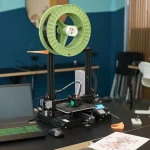

At Telespace, we’ve witnessed first-hand how 3D printing has evolved—from a futuristic concept to a practical tool that enhances how we design, build, and interact with everyday objects. It’s no longer just about prototypes or novelty gadgets. 3D printing is becoming a vital part of how industries operate, from medicine to construction, fashion to aerospace.
Now, we’re entering a new phase. As we explore and contribute to the future of additive manufacturing, it’s clear that this field is growing beyond hardware. It’s reshaping mindsets, workflows, and entire supply chains. The trends that are emerging now won’t just expand possibilities—they’ll redefine how we think about materials, design, and even biology.
Here are five of the most exciting and impactful trends shaping the next generation of 3D printing.
The Rise of 4D Printing
3D printing laid the groundwork for custom design, but 4D printing takes it a step further by adding a dynamic dimension—time. In 4D printing, smart materials are used that can change shape or behavior over time in response to external stimuli like heat, water, pH, or light.
This technology has huge potential in industries like healthcare, aerospace, and construction. Imagine stents that expand automatically inside the body, or self-deploying shelters that assemble when exposed to sunlight or moisture.
Scientists at MIT, for example, have demonstrated how printed structures can fold, expand, or contract without motors or electronics. The materials remember their original shape and respond in real-time—essentially allowing the printed object to “think” for itself.
This fluidity of design echoes the growing demand for printed solutions that adapt to real-life use, an idea we explored when discussing how custom 3D models are changing consumer experiences.
While still developing, 4D printing is already being used in experimental projects and smart textiles. As it matures, it could eliminate the need for mechanical parts in certain applications and allow us to design for environments where traditional components simply wouldn’t survive.
Localised, On-Demand Manufacturing
The global pandemic exposed a key weakness in modern supply chains: centralisation. Delays, shortages, and shipping issues became widespread. That’s where 3D printing really proved its value. It enabled decentralised, on-demand production, where parts and products could be printed on-site or closer to the end-user.
This trend is continuing to gain momentum. Localised print hubs and micro-factories are now being established around the world, including here in Australia. Instead of waiting weeks for a replacement component, a farmer, for instance, can now print a spare part in hours from a local service.
For businesses, this means reduced logistics costs, lower carbon emissions, and faster turnaround times. For consumers, it offers the potential for near-instant access to custom or low-volume products.
At Telespace, we’re actively embracing this direction—making production not just faster and more efficient, but smarter and more responsive to real-world needs.
Bioprinting Breakthroughs
Bioprinting is one of the most extraordinary uses of 3D printing. Instead of plastics or metals, it uses bio-inks made of living cells to build tissues, skin, and even simplified organs.
Researchers are already printing human skin for burn victims, dental pulp for root canal therapy, and cartilage for joint injuries. Major milestones have been achieved in printing vascular structures—blood vessels being one of the most complex tissue types due to their structure and function.
While printing fully functional human organs like hearts and kidneys is still years away, progress is steady. Bioprinting is likely to transform transplant surgery, pharmaceutical testing, and even cosmetic treatments.
The idea that printed materials can become seamlessly integrated into daily life may sound futuristic, but it’s already happening—especially in areas where medical customisation meets function.
Even in its early stages, the implications are immense: reducing donor shortages, enabling personalised implants, and creating lab-grown alternatives for ethical testing.
Sustainable Materials and Circular Design
Sustainability is no longer optional—it’s the foundation of forward-thinking manufacturing. 3D printing is evolving from plastic-heavy origins to embrace greener, circular practices. This includes the use of biodegradable and recycled materials, and designing with waste reduction in mind.
New materials derived from algae, corn starch, bamboo, and even industrial waste are being transformed into printable filaments. Researchers are also exploring how to convert food waste and CO₂ emissions into usable raw materials. At the same time, the technology enables exact material use, meaning there’s little to no scrap or excess.
More companies are beginning to close the loop—recycling failed prints, repurposing prototypes, and turning end-of-life products back into raw material. This aligns perfectly with circular economy principles, where waste becomes the input for new products.
At Telespace, we’re excited about innovations like zero-waste prototyping and carbon-neutral printing, which match our broader vision of design that respects both creativity and the planet.
AI-Driven Design and Automation
The fusion of artificial intelligence with 3D printing is giving rise to a new wave of generative design. With AI-powered tools, designers can set performance requirements—such as weight, strength, or flexibility—and the software generates multiple optimized shapes and structures based on those criteria.
These shapes are often incredibly efficient and organic, mimicking forms found in nature. Think of honeycombs, bird bones, or coral reefs—patterns that are strong yet lightweight.
AI integration is also helping reduce the need for deep technical knowledge, opening the door for non-engineers, students, and independent creators to explore advanced product design. This democratizes innovation and makes rapid prototyping faster and more cost-effective.
Robotics and machine learning are increasingly being used to automate the printing process too—managing print queues, detecting failures, and even correcting issues in real-time.
The Printed Possibility Ahead
What these trends show us is clear: 3D printing is no longer just about replicating existing ideas. It’s about rethinking what’s possible from the ground up—adapting to users, responding to the environment, and reshaping how we approach design and production.
At Telespace, we’re excited by where this technology is headed—and how it continues to blur the lines between imagination and creation. Whether it’s building with living cells, designing with zero waste, or enabling smarter, decentralised manufacturing, the future of 3D printing is already unfolding.
And just like in “The Future is Custom,” the story ahead is deeply personal, endlessly flexible, and entirely shaped by those who dare to print it.